Choosing the right cutting technology can significantly impact precision, cost, and production efficiency. At GKH Engineering Solutions, we often guide businesses in selecting the ideal method for their specific applications, whether in automotive, aerospace, construction, electronics, or medical devices.
Understanding the differences between Fiber Laser Cutting, Plasma Cutting, and Water Jet Cutting is essential for making the right choice. Each technology has its advantages, limitations, and ideal use cases.
Fiber Laser Cutting
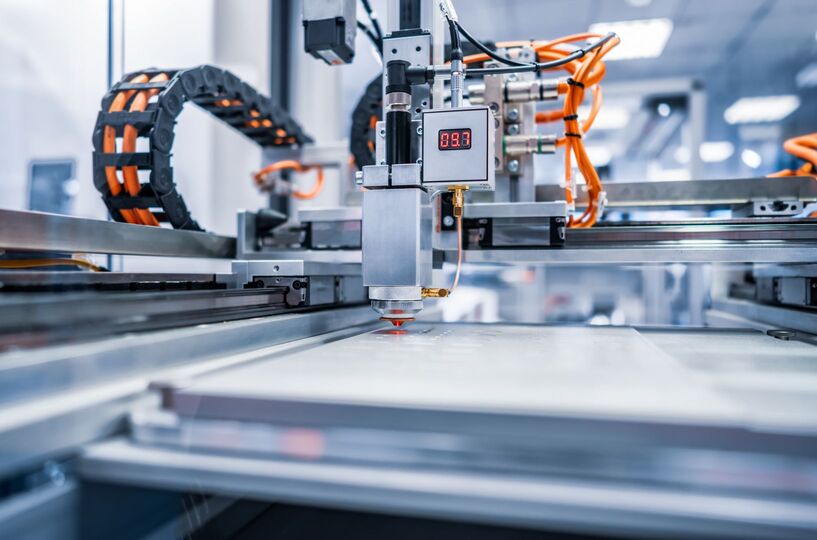
Overview: Fiber laser cutting uses a highly concentrated laser beam to cut metals with extreme precision. It is highly automated and integrates seamlessly with CNC and CAD systems.
What Businesses Can Expect:
-
Precision: Tolerances as tight as ±0.03 mm for intricate components.
-
Speed: Excellent for thin to medium metals like steel, aluminum, brass, and copper.
-
Efficiency: Low maintenance and high repeatability for bulk orders.
-
Applications: Automotive panels, electronics enclosures, aerospace brackets, medical components.
-
Limitations: Less effective for very thick metals above 25–30 mm.
Real-Life Example: An automotive client required engine brackets with intricate cutouts. Using fiber laser cutting, GKH delivered highly accurate parts in a single operation, reducing assembly rework by 35%.
Plasma Cutting
Overview: Plasma cutting uses ionized gas at high temperature to cut through electrically conductive metals. It is ideal for thicker materials and large-scale projects.
What Businesses Can Expect:
-
Material Range: Mild steel, stainless steel, and aluminum up to 100 mm thick.
-
Speed: Faster on thick metals compared to traditional cutting methods.
-
Cost Efficiency: Less expensive for heavy industrial applications.
-
Applications: Construction beams, heavy machinery parts, shipbuilding, industrial equipment.
-
Limitations: Lower precision compared to fiber laser; tolerances typically ±0.5 – 1 mm.
Real-Life Example: A construction company needed structural steel beams cut to specific dimensions. GKH used plasma cutting to complete the project efficiently, reducing material waste by 20%.
Water Jet Cutting
Overview: Water jet cutting uses a high-pressure jet of water mixed with abrasive materials to cut metals and other materials without heat, avoiding thermal distortion.
What Businesses Can Expect:
-
Heat-Sensitive Materials: Ideal for aluminum, titanium, and composite metals.
-
Precision: Tolerances of ±0.1 – 0.3 mm with smooth finishes.
-
Versatility: Can cut metal, stone, glass, and composites.
-
Applications: Aerospace components, medical implants, precision industrial parts.
-
Limitations: Slower than laser cutting for thin metals; higher operating cost for large volumes.
Real-Life Example: A medical device manufacturer required titanium surgical tools with no heat-affected zones. GKH’s water jet cutting produced precise, distortion-free components within tight tolerances.
How to Choose the Right Cutting Technology
| Factor | Fiber Laser Cutting | Plasma Cutting | Water Jet Cutting |
|---|---|---|---|
| Material Thickness | Thin to medium (up to 25–30 mm) | Thick metals (up to 100 mm) | All thicknesses, heat-sensitive |
| Tolerance | ±0.03 – 0.05 mm | ±0.5 – 1 mm | ±0.1 – 0.3 mm |
| Speed | High for thin/medium | Fast for thick metals | Moderate |
| Heat-Affected Zone | Minimal | Present | None |
| Applications | Automotive, aerospace, electronics, medical | Construction, heavy machinery, shipbuilding | Aerospace, medical, precision fabrication |
| Cost Efficiency | High for precision & bulk | High for thick metals | Moderate; slower process |
Why GKH Engineering Solutions
At GKH Engineering Solutions, we help businesses choose the right cutting technology for their materials, design complexity, and production requirements. Our advanced CNC and fiber laser machines, plasma cutters, and water jet systems allow us to provide flexible, high-precision solutions for any industry.
We guide clients through:
-
Material and thickness evaluation
-
Cost and production speed comparison
-
Tolerance requirements and quality standards
-
Final application and scalability needs
Conclusion
Choosing the right cutting method is critical for cost, precision, and efficiency. Fiber lasers excel in precision and speed for thin to medium metals, plasma is ideal for thick metals and heavy industrial applications, and water jet cutting ensures heat-free, precise results for sensitive or complex materials.
At GKH Engineering Solutions, we combine technology, experience, and industry knowledge to deliver optimal laser cutting solutions for clients across all over India.
Contact us today to discuss your project and discover which cutting technology will give you the best results with maximum efficiency.